
Agentic AI vs. Chatbots: Why the Difference Matters for Enterprise Buyers
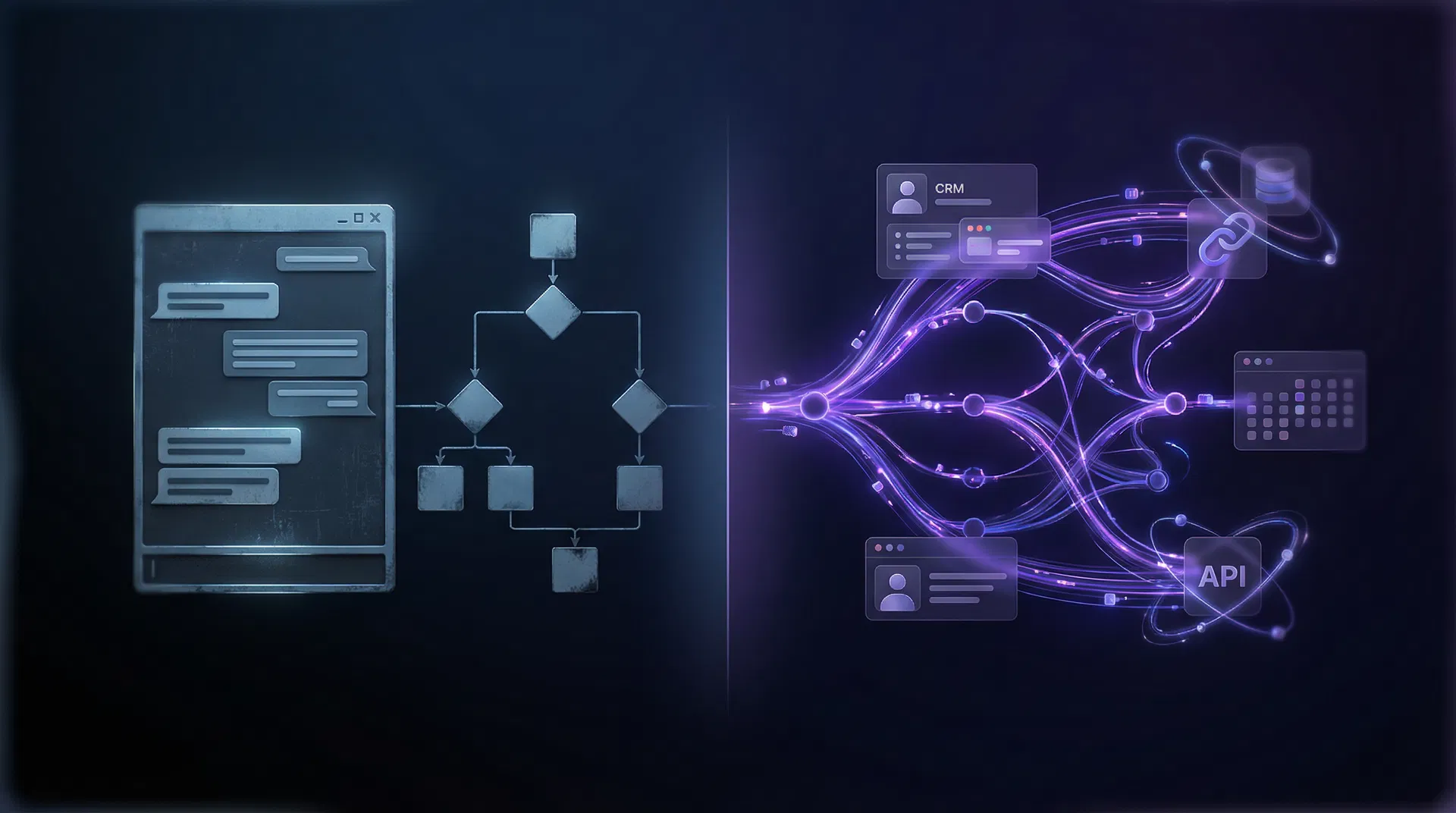
Most enterprise AI journeys begin the same way: a chatbot gets deployed to handle customer inquiries, the demo impresses the board, and within six months the team is quietly managing a backlog of complaints about responses that miss the point. The technology worked exactly as designed — it answered questions. The problem is that answering questions was never the actual business need.
The business needed outcomes. That distinction — between a system that responds and a system that acts — is the defining line between a chatbot and an AI agent, and understanding it is now a strategic requirement for any organisation serious about AI-driven growth.
What exactly is the difference between a chatbot and an AI agent?
At the most fundamental level, a chatbot is a reactive system. It waits for a user to ask a question, retrieves or generates a response from its knowledge base or language model, and returns that response. The interaction is transactional and stateless — the chatbot has no memory of previous conversations, no ability to take action in external systems, and no capacity to pursue a goal across multiple steps. It is, in essence, a very sophisticated FAQ engine.
An AI agent operates on an entirely different architecture. Rather than simply responding to prompts, an agent is given a goal and the tools to pursue it. It can access external systems via APIs — a CRM, a calendar, a payment processor, an inventory database — and it can execute sequences of actions to move toward that goal without requiring a human to direct each step.
When a mortgage broker's AI agent receives a lead inquiry at 2 a.m., it does not just reply with a welcome message. It qualifies the lead, pulls the applicant's financial profile, schedules a callback, and logs the interaction in the CRM. The broker arrives in the morning to a pre-qualified, pre-scheduled appointment. That is the difference between information delivery and outcome delivery.
RingCentral's enterprise research team put it plainly: "Chatbots can provide information. AI agents deliver outcomes." The framing is simple, but the operational implications are significant. A chatbot reduces the cost of answering questions. An agent reduces the cost of completing work.
Why do chatbots consistently fail at enterprise scale?
The failure rate of enterprise chatbot deployments is well-documented. Research from TeamDynamix found that 61% of chatbot interactions fail because the system cannot understand the user's query, and 45% of users abandon chatbot interactions before resolving their issue. These are not edge cases — they are the norm.
The root causes are structural rather than technical. Chatbots are built on scripted decision trees or, in more modern implementations, retrieval-augmented generation from a static knowledge base. Both approaches share the same fundamental limitation: they can only work with information they already have, and they can only respond — they cannot act. When a customer asks a chatbot to reschedule a delivery, check whether a refund has been processed, or explain why their mortgage application was flagged, the chatbot can only provide the answer if that exact information exists in its knowledge base. It cannot query the logistics system, check the payments ledger, or pull the underwriting notes.
Enterprise environments compound this problem. Large organisations operate across dozens of systems — ERPs, CRMs, ticketing platforms, communication tools, databases — and the information a customer or employee needs is rarely contained in a single place. A chatbot that cannot traverse these systems cannot resolve the underlying issue. It can only describe it, which is precisely what frustrates users and erodes trust in AI deployments.
How does the memory gap between chatbots and agents affect business outcomes?
One of the most underappreciated differences between chatbots and AI agents is memory. Traditional chatbots are stateless: each conversation begins from scratch, with no knowledge of previous interactions. A customer who contacted support three times about the same unresolved issue will receive the same scripted response on the fourth attempt, with no acknowledgement of the history. This is not just a poor experience — it actively damages customer relationships and increases the cost of resolution.
Agentic AI systems maintain persistent memory across sessions. They can recall previous interactions, track the status of ongoing tasks, and adapt their behaviour based on accumulated context. A real estate AI agent that has been working with a buyer for three weeks knows their budget range, preferred neighbourhoods, timeline, and which properties they have already viewed. Every subsequent interaction builds on that foundation rather than starting over. The cumulative effect on customer experience — and on conversion rates — is substantial.
DigiForm builds and deploys AI agents for mortgage brokers, real estate professionals, and e-commerce operators — systems that qualify leads, book appointments, and follow up autonomously while your team focuses on closing.
See how DigiForm's AI agents work in your industryWhat are the five architectural differences that define agentic AI?
Understanding why agents outperform chatbots requires looking at the architectural differences that separate them. These are not incremental improvements — they represent a fundamentally different design philosophy.
01Tool use & system integration
Agents are equipped with APIs, function calls, and database connectors that allow them to interact with external systems. A chatbot can tell you your order is delayed. An agent can access the logistics API, identify the delay reason, initiate a re-routing request, and send a proactive update — all in one interaction.
02Autonomous planning
When given a goal, an agent breaks it down into sub-tasks and executes them in sequence or in parallel. This planning capability allows agents to handle complex, multi-step workflows that would require multiple chatbot interactions — or human intervention — to complete.
03Decision-making autonomy
Agents assess real-time conditions and choose the best course of action from a defined set of options. They are not following a rigid script — they are evaluating context and making judgements. This allows them to handle the edge cases and exceptions that cause chatbots to fail.
04Persistent memory
Agents maintain context across sessions, enabling them to build relationships with users over time and provide increasingly personalised and efficient service. Each interaction builds on the last rather than starting from scratch.
05Continuous learning
Unlike chatbots that require manual updates to incorporate new information or fix errors, well-designed agents improve through use. They learn from successful and unsuccessful interactions, refining their behaviour over time without requiring a full redeployment.
How are enterprise organisations deploying AI agents in practice?
The adoption curve for agentic AI has accelerated sharply. McKinsey's 2025 State of AI report found that 62% of organisations are at least experimenting with AI agents, and PagerDuty's survey found that 51% have already deployed them in production. The AI agents market reached $7.92 billion in 2025 and is projected to hit $11.55 billion in 2026, growing at a compound annual rate of 45.82% through 2034.
The industries seeing the fastest adoption are those with high volumes of structured, repeatable interactions: financial services, real estate, e-commerce, healthcare administration, and insurance. In each of these sectors, the pattern is consistent — agents are deployed first in the highest-volume, lowest-complexity workflows (lead qualification, appointment scheduling, order status resolution), then progressively extended into more complex territory as confidence in the technology grows.
Google Cloud's research found that 74% of executives report achieving ROI within the first year of AI agent deployment, and 39% have already deployed more than ten agents across their organisations. Master of Code documents 128% ROI in customer experience deployments and 35% faster lead conversion rates. These are not projections — they are outcomes from production deployments.
What does a well-designed AI agent deployment look like?
The most effective agent deployments share several characteristics. They begin with a clearly scoped use case — not "AI for customer service" but "an agent that qualifies inbound mortgage leads between 6 p.m. and 8 a.m. and schedules callbacks for the next business day." Specificity of scope is the single most important factor in early deployment success.
Defined escalation paths
When an agent encounters a situation outside its scope — a complex complaint, an emotionally distressed customer, a request requiring human judgement — it hands off gracefully with full context preserved. The handoff experience is as important as the agent's autonomous performance.
Deep system integration
An agent that cannot access the CRM, the calendar, and the communications platform cannot complete the workflows it is designed for. Integration depth is the primary determinant of agent capability.
Governance from day one
Every agent action should be logged, every decision auditable. In regulated industries, this is a compliance requirement. In all industries, it is a trust requirement. Organisations that deploy agents without governance frameworks lose confidence when errors occur — not because errors are catastrophic, but because they cannot explain what happened or why.
Ready to move beyond chatbots? DigiForm's AI agent implementations are scoped, integrated, and governed from day one — so you get measurable outcomes, not just a demo that impresses the board.
Start your AI agent deployment with DigiFormFrequently Asked Questions
Conclusion
The chatbot era served a purpose. It proved that AI could handle structured, high-volume interactions at scale, and it built the organisational confidence needed to invest in more capable systems. But the limitations of chatbots — their inability to act, their lack of memory, their disconnection from the systems where work happens — have become the ceiling on enterprise AI ambition.
Agentic AI removes that ceiling. It shifts the question from "can AI answer this?" to "can AI complete this?" — and the answer, increasingly, is yes. For organisations that have already exhausted what chatbots can offer, the path forward is not a better chatbot. It is a fundamentally different kind of system, built to deliver outcomes rather than responses.
Related Articles
Agentic AI vs. Chatbots: Why the Difference Matters for Enterprise Buyers
Chatbots answer questions. AI agents take action. Learn the five architectural differences that separate them, why chatbots fail at enterprise scale, and how agentic AI delivers measurable business outcomes.

Measuring AI Fluency ROI: A Framework for Quantifying Executive Education Impact
Learn advanced frameworks for measuring AI fluency ROI including impact chaining and risk-adjusted metrics. Discover why 45% of executives report disappointing AI returns and how to quantify strategic capability development.

From AI Literacy to Strategic AI Leadership: The Executive Transformation Journey
Learn the 4-stage progression from AI awareness to transformational leadership. Discover why literacy alone fails 95% of AI initiatives and how to build organizational capabilities for sustained AI advantage.